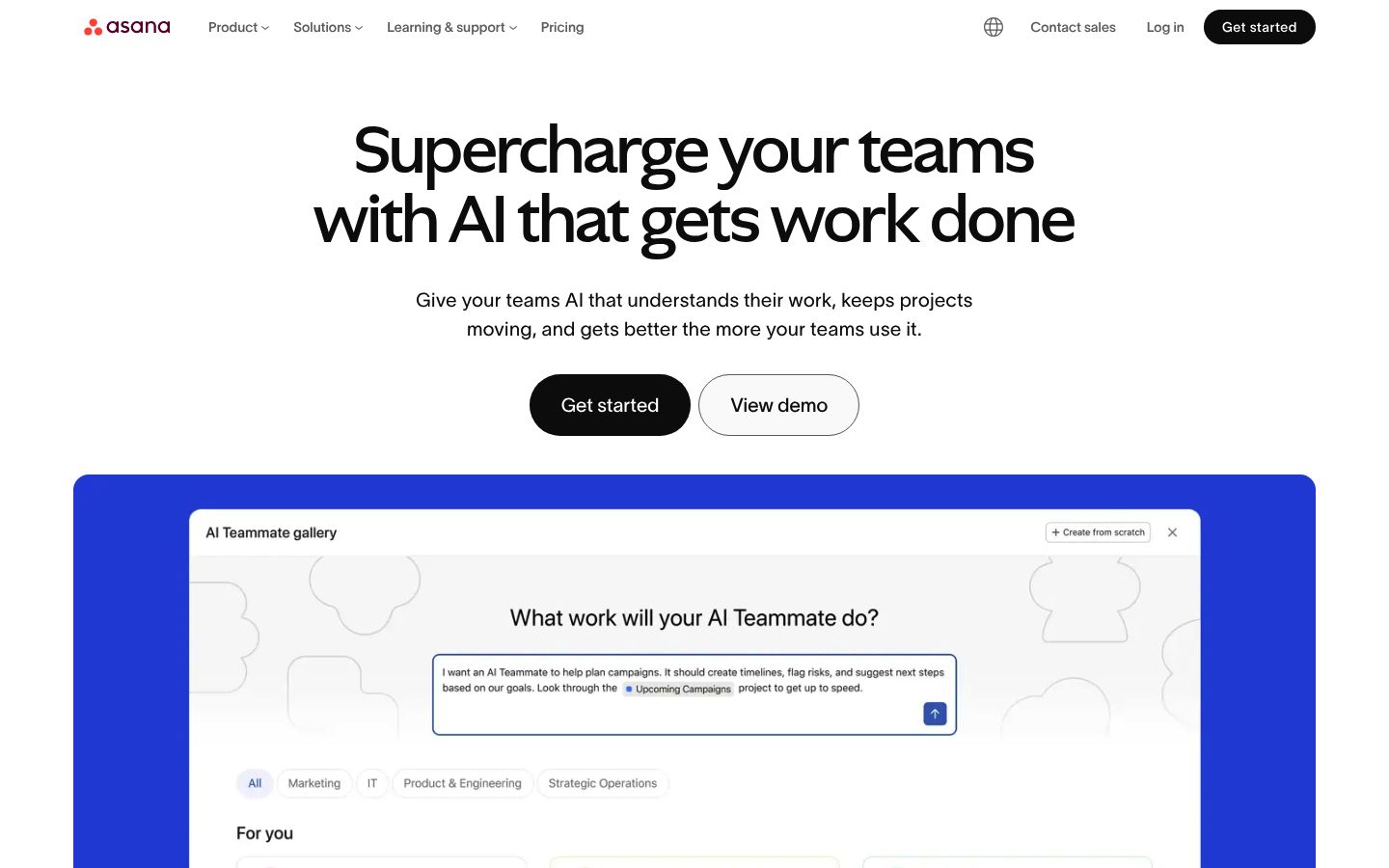
Where Asana wins and where it leaks.
Asana’s strongest dimension is Post-click.
Post-click scores 8.1 / 10. The dim covers 4 signals in the rubric; no findings landed against it on this page — clean execution.
What’s costing Asana, quoted from the page.
- 01Page claims pricing transparency but buyers flag it as a red flag
“'Get started' (sole CTA; no pricing tier, no free-plan mention, no per-seat cost shown anywhere on the page)”
The landing page offers no visible pricing, no free-plan path, and no per-seat cost information — only 'Get started' CTAs — while the buyer-voice table stakes explicitly list 'pricing visible without a sales call' and 'free plan or free trial path clearly shown,' and buyer red flags call out 'pricing that scales into chaos as headcount grows.'
- 02There's a 'View demo' CTA in the hero but no path to a live sales conversation.
“The hero contains 'Get started' and 'View demo' only. No 'Request a demo,' 'Talk to sales,' or 'Contact us' link appears above the fold. The page's own proof signals — CIO-level quotes, Fortune 100 stat, Gartner/Forrester badges — signal an enterprise buyer who expects a human co…”
There's a 'View demo' CTA in the hero but no path to a live sales conversation. Enterprise buyers at Fortune 100 companies don't self-onboard from a demo video — they need a 'Talk to sales' route that meets them where they are.
- 03The headline drops what Asana is to chase a generic AI claim.
“Supercharge your teams with AI that gets work done | Give your teams AI that understands their work, keeps projects moving, and gets better the more your teams use it.”
Your headline names neither the product category nor the specific thing your AI does — it could be a chatbot, a CRM add-on, anything. 'AI that gets work done' is the same claim every competitor in this space is making right now. For an enterprise buyer already shopping work management tools, there's no hook here.
- 04The hero offers self-serve signup but no path to talk to sales.
“Get started / View demo — no 'Contact Sales' or 'Talk to an expert' option in the hero or anywhere above the trust badges”
The hero pushes 'Get started' as if buyers self-onboard, but the page is built around enterprise proof — Fortune 100 stats, CIO and Director-level quotes, Gartner and Forrester badges. There's no prominent path for an enterprise buyer who's ready to talk to a human. 'View demo' reads as a recorded walkthrough, not a sales conversation.
- 05The page attempts AIDA but drops the Desire step for a feature list.
“Marketing: Maximize campaign ROI / Streamline campaign management / Enhance creative production / Manage events and editorial calendars. Operations: Drive better outcomes / Track work and see progress in real time / Standardize and automate processes / Unblock teams to hit revenu…”
The page opens with a clear Attention beat (the AI headline) and an Interest beat (social proof, Gartner/Forrester). But where Desire should live — the part that makes someone feel the difference between Asana and the three other tabs they have open — the page drops into a department-by-department feature list. AIDA without the Desire step skips the emotional commitment that moves a buyer from 'yes I know this product' to 'this is the one I'm recommending internally.' For buyers who are already most-aware and comparing Asana directly against Monday.com or Smartsheet, a feature grid doesn't tip the decision.
Asana’s page vs what its buyers actually say.
The page’s headline + body language overlaps 33% with phrases buyers in this category use in reviews + interviews. Top-tier landing pages typically land in the 35-55% range; below that, the page is speaking analyst rather than buyer.
- “real-time visibility”
- “customizable workflows”
- “all-in-one workspace”
- “track tasks and deadlines in one place”
- “ownership needs to be defined”
- “status needs to live somewhere other than a conversation or memory”
Asana’s other surfaces.
- asana.comHomepage
- asana.com/pricingTracked
- asana.com/customersTracked
About Asana’s Lytms scan.
What did Lytms score Asana's homepage?
What's Asana's strongest dimension?
What's the weakest dimension on Asana's page?
What's the biggest leak on Asana's homepage?
When was Asana's page last scanned?
One-click citation for press, blog, and academic use.
Lytms scans of public B2B SaaS landing pages are independent and free to cite. Pick a format below and we’ll copy it to your clipboard.
Lytms Research Team. (2026). Asana landing page review (Lytms score 5.6/10). Retrieved May 20, 2026 from https://lytms.ai/brand/asana
Score yours like Asana. See yours.
One URL. About 2 minutes.