Datadog scored 5.1/10.
The page promises "AI-driven root cause analysis" and "actionable alerts" — terms buyers search for — but never demonstrates either.
Where Datadog wins and where it leaks.
Datadog’s strongest dimension is Post-click.
Post-click scores 6.2 / 10. The dim covers 4 signals in the rubric; no findings landed against it on this page — clean execution.
What’s costing Datadog, quoted from the page.
- 01The homepage speaks to buyers who already know Datadog; most traffic doesn't.
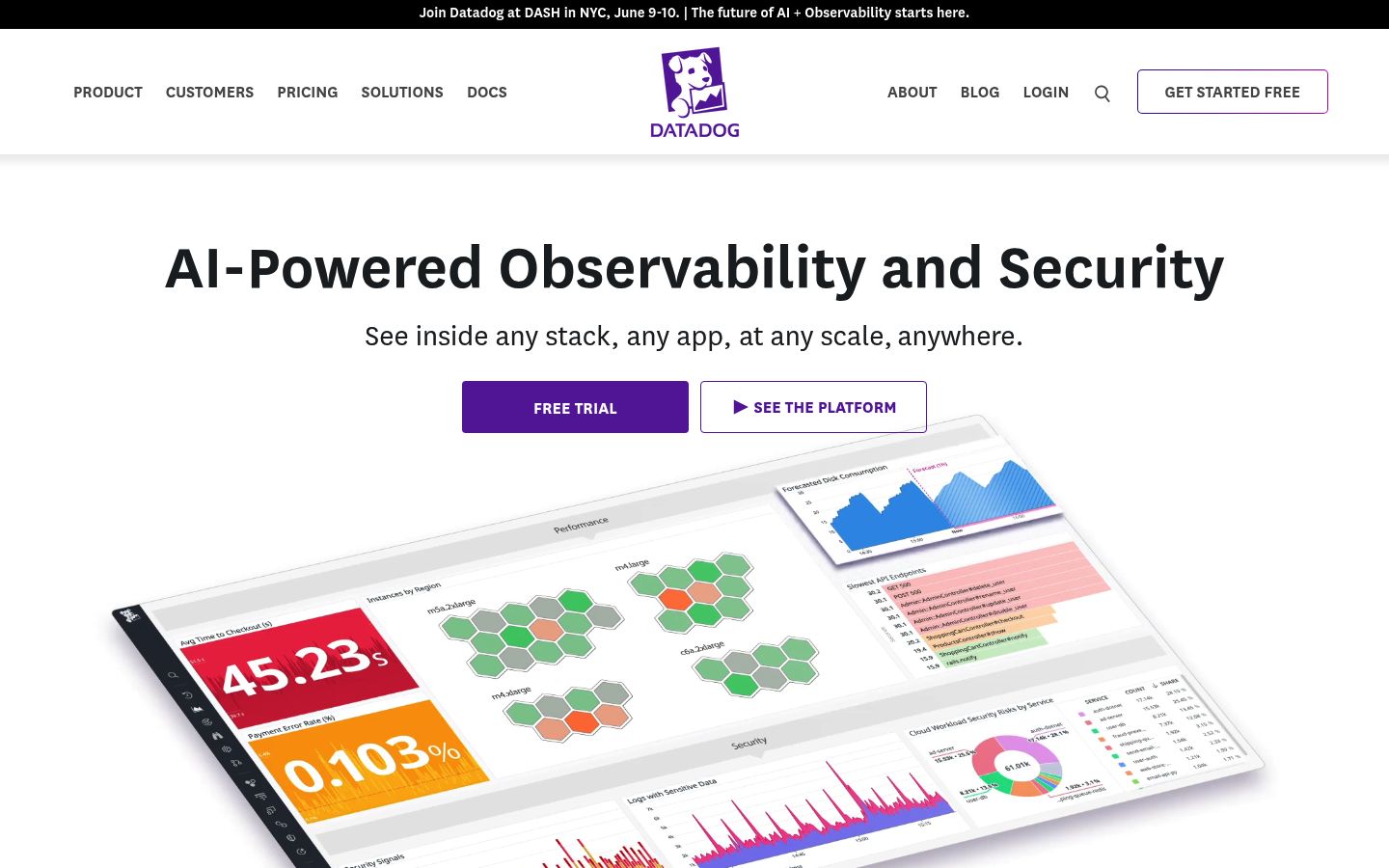
“The homepage leads with 'AI-Powered Observability and Security' and a Free Trial button — copy that assumes the visitor already knows what observability is and why they'd want it. But 80.66% of inbound search volume is unaware-level traffic, including the top-volume keywords 'aws…”
Your page opens with category jargon — 'observability,' 'any stack, any scale' — and jumps straight to a Free Trial button. That path only works if someone already knows they need an observability platform and is comparing vendors. At 80.66% unaware and 1.94% product-aware, the page is built for a sliver of the audience it actually gets. There's no path here — no plain-language explanation of what the problem is, no 'here's why you'd care' bridge — for the dominant cohort.
- 02Named customer logos are absent from the page entirely.
“The social proof band reads 'Thousands of customers love & trust Datadog' with no logos, no company names, no industry verticals. Customer logos are confirmed to exist. None appear on the homepage.”
Named customer logos are absent from the page entirely. Datadog has thousands of customers and Gartner Leader status, but a visiting engineer sees none of the companies they'd recognize.
- 03Noise reduction and actionable alerts are buyer priorities absent from page
“Security Monitoring: Identify potential threats to your systems in real time / Log Management: Analyze and explore your logs for rapid troubleshooting”
52% of buyers cite 'noise reduction in alerts' and 38% cite 'actionable alerts' as explicit purchase criteria, and both appear as red flags ('alert fatigue from tools that don't correlate or reduce noise'). The landing page lists Security Monitoring and Log Management but makes no mention of alert correlation, noise reduction, or actionable alerting anywhere in the visible body copy or product grid.
- 04Your social proof line uses consumer language for enterprise buyers.
“Thousands of customers love & trust Datadog”
The page puts 'love & trust' in your primary proof slot — soft, emotional language that sits oddly right above Gartner and Forrester recognition. Platform engineers evaluating enterprise tooling skip sentiment and look for evidence. This slot says feeling where buyers want fact.
- 05Your subheadline says nothing a competitor couldn't also say.
“AI-Powered Observability and Security | See inside any stack, any app, at any scale, anywhere.”
The page opens with a category label and four 'any' claims that Dynatrace, New Relic, and Splunk could run unedited. For platform-aware engineers already comparison-shopping, there's no WHY here — no outcome, no stake, no reason to pick Datadog over the next tab.
Datadog’s other surfaces.
- datadoghq.comHomepage
- datadoghq.com/pricingTracked
- datadoghq.com/customersTracked
About Datadog’s Lytms scan.
What did Lytms score Datadog's homepage?
What's Datadog's strongest dimension?
What's the weakest dimension on Datadog's page?
What's the biggest leak on Datadog's homepage?
How does Datadog compare to peers?
When was Datadog's page last scanned?
One-click citation for press, blog, and academic use.
Lytms scans of public B2B SaaS landing pages are independent and free to cite. Pick a format below and we’ll copy it to your clipboard.
Lytms Research Team. (2026). Datadog landing page review (Lytms score 5.1/10). Retrieved May 20, 2026 from https://lytms.ai/brand/datadog
Score yours like Datadog. See yours.
One URL. About 2 minutes.