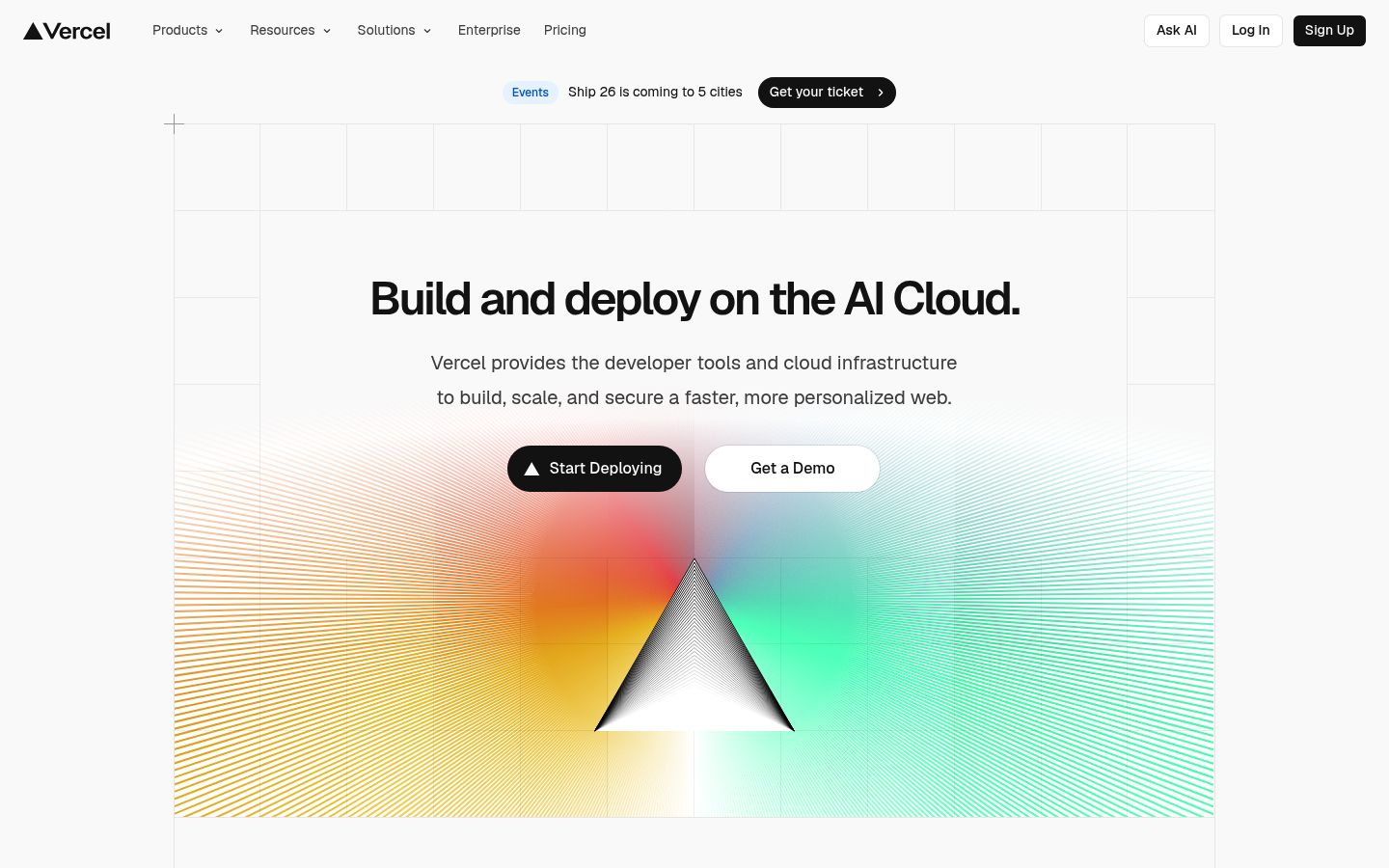
The page opens with “Build and deploy on the AI Cloud” and then immediately fractures into five parallel tracks — AI Apps, Web Apps, Ecommerce, Marketing, Platforms — each with its own feature pitch. The hero claims a single category (“the AI Cloud”) but the body delivers a product catalog. A developer landing here to solve a specific problem — deploying an AI app, scaling a multi-tenant platform, routing model requests — has to do the work of figuring out which of the five tracks is theirs before they can evaluate whether Vercel solves it. The move is to pick the one buyer this page is built to convert first and build the scroll path around their specific problem; the tab-switching architecture works in a product UI, not on a homepage where the visitor hasn’t yet committed to staying.
The hero on Vercel’s page as we read it.
Build and deploy on the AI Cloud.
Where Vercel wins and where it leaks.
Vercel’s strongest dimension is CTA & Offer.
CTA & Offer scores 7.2 / 10. The dim covers 5 signals in the rubric; the page still has 1 finding in this area, but the overall score is strong relative to peers.
Structural patterns on Vercel’s page worth knowing.
The performance metrics in the social proof strip — “build times went from 7m to 40s,” “95% reduction in page load times,” “24x faster builds” — appear without a single named team behind them. These are the strongest numbers on the page and they’re doing almost nothing because the visitor has no way to verify or contextualize them. Vercel’s own footer says “Trusted by the best teams” and the page elsewhere references enterprise customers, which means named proof exists somewhere in the brand’s asset library. Move at least two named attributions — company name, role, specific context — into the proof strip directly beneath the hero, where the visitor is still deciding whether to scroll.
The AI Gateway leaderboard — a live ranked list of top models by usage percentage on June 7, 2026 — is a genuinely differentiated product signal buried in the middle of the page with no framing that explains why it matters to the visitor. The implicit claim is powerful: Vercel sees real-time model traffic across the ecosystem and can show developers which models are actually being used, not just marketed. That’s a category-defining data asset. Right now it reads as a widget. Promote it above the leaderboard with one sentence that names the claim — something like “we route [X] model requests per day across [Y] providers; here’s what developers are actually running” — so the visitor understands what they’re looking at before they look at it.
The page carries two structurally incompatible conversion paths without distinguishing who each one is for. “Start Deploying” is a self-serve, zero-friction action aimed at an individual developer who wants to ship something today. “Get a Demo” and “Talk to an Expert” and “Get an Enterprise Trial” are sales-assisted paths aimed at a team buying decision. Both paths appear at the top of the page, side by side, with no signal to the visitor about which one fits their situation. The self-serve developer reads “Get a Demo” and feels like they’ve landed on an enterprise vendor’s site; the enterprise buyer reads “Start Deploying” and wonders if there’s a real sales process. Separate the paths visually and contextually: self-serve above, enterprise below, with a brief qualifier (“deploying solo?” / “scaling a team?”) so each visitor self-selects without friction.
What’s costing Vercel, quoted from the page.
- 01Customer logos appear in the nav as 'Trusted by the best teams' but never surface on the page itself.
“The page body contains zero named customer logos or company names in the visible content. The nav link points to a /customers page that exists off-page. The social proof strip has three strong metrics but no company attribution. Customer logos are confirmed available but none are…”
Customer logos appear in the nav as 'Trusted by the best teams' but never surface on the page itself. Engineers evaluating infrastructure don't take 'best teams' on faith — they want to see who.
- 02Buyers demand explicit uptime SLA; marketing and docs surface none
“Security, speed, and AI included, so you can focus on your user. … Fast load times, zero overhead with Vercel's highly optimized infrastructure and CDN.”
Buyers rank 'reliable uptime' at 90% frequency and list 'vague or missing uptime guarantees — buyers walk away when SLA is not stated' as a red flag, yet the landing page contains no uptime percentage, SLA commitment, or status-page reference anywhere in the visible copy.
- 0312 blog posts. Zero customer stories. The proof gap shows.
“Page library: 12 blog posts indexed, 0 customer-story pages classified across 51 discovered pages on this domain.”
You're investing in content marketing — the inbound funnel is built. But visitors who land on a blog post and bounce to your homepage have no proof artifacts to land on. Customer-story pages convert at 4-8x the rate of generic feature pages because they let visitors verify "people like me succeed here." The asymmetry says proof-gathering is under-invested vs content production.
- 04Your three strongest metrics have no company attached to them.
“build times went from 7m to 40s. saw a 95% reduction in page load times. saw 24x faster builds.”
The page surfaces three impressive, specific metrics — but strips the company name from every one. At your stage, competing against AWS and GCP for engineering teams who vet infrastructure choices carefully, anonymous stats read as unverifiable. The numbers are good enough to earn attribution; without it, they get discounted rather than believed.
- 05The subheadline swaps the AI-native reason-to-choose for generic cloud promises.
“Build and deploy on the AI Cloud. | Vercel provides the developer tools and cloud infrastructure to build, scale, and secure a faster, more personalized web.”
The headline stakes a brand position — "AI Cloud" — that the subheadline immediately deflates with category-generic language any cloud provider could claim. "Build, scale, and secure a faster, more personalized web" names no outcome specific to AI workloads, framework-aware provisioning, or the model gateway that actually separates Vercel from its peers.
Vercel’s page vs what its buyers actually say.
The page’s headline + body language overlaps 33% with phrases buyers in this category use in reviews + interviews. Top-tier landing pages typically land in the 35-55% range; below that, the page is speaking analyst rather than buyer.
- “easy setup”
- “flexibility for scaling”
- “high-performance hardware”
- “no lag and stable ping”
- “reliable uptime”
- “affordable pricing”
Vercel’s other surfaces.
- vercel.comHomepage
- vercel.com/pricingTracked
- vercel.com/aiTracked
About Vercel’s Lytms scan.
What did Lytms score Vercel's homepage?
What's Vercel's strongest dimension?
What's the weakest dimension on Vercel's page?
What's the biggest leak on Vercel's homepage?
How does Vercel compare to peers?
When was Vercel's page last scanned?
One-click citation for press, blog, and academic use.
Lytms scans of public B2B SaaS landing pages are independent and free to cite. Pick a format below and we’ll copy it to your clipboard.
Lytms Research Team. (2026). Vercel landing page review (Lytms score 6.0/10). Retrieved June 7, 2026 from https://lytms.ai/brand/vercel
Score yours like Vercel. See yours.
One URL. About 2 minutes.