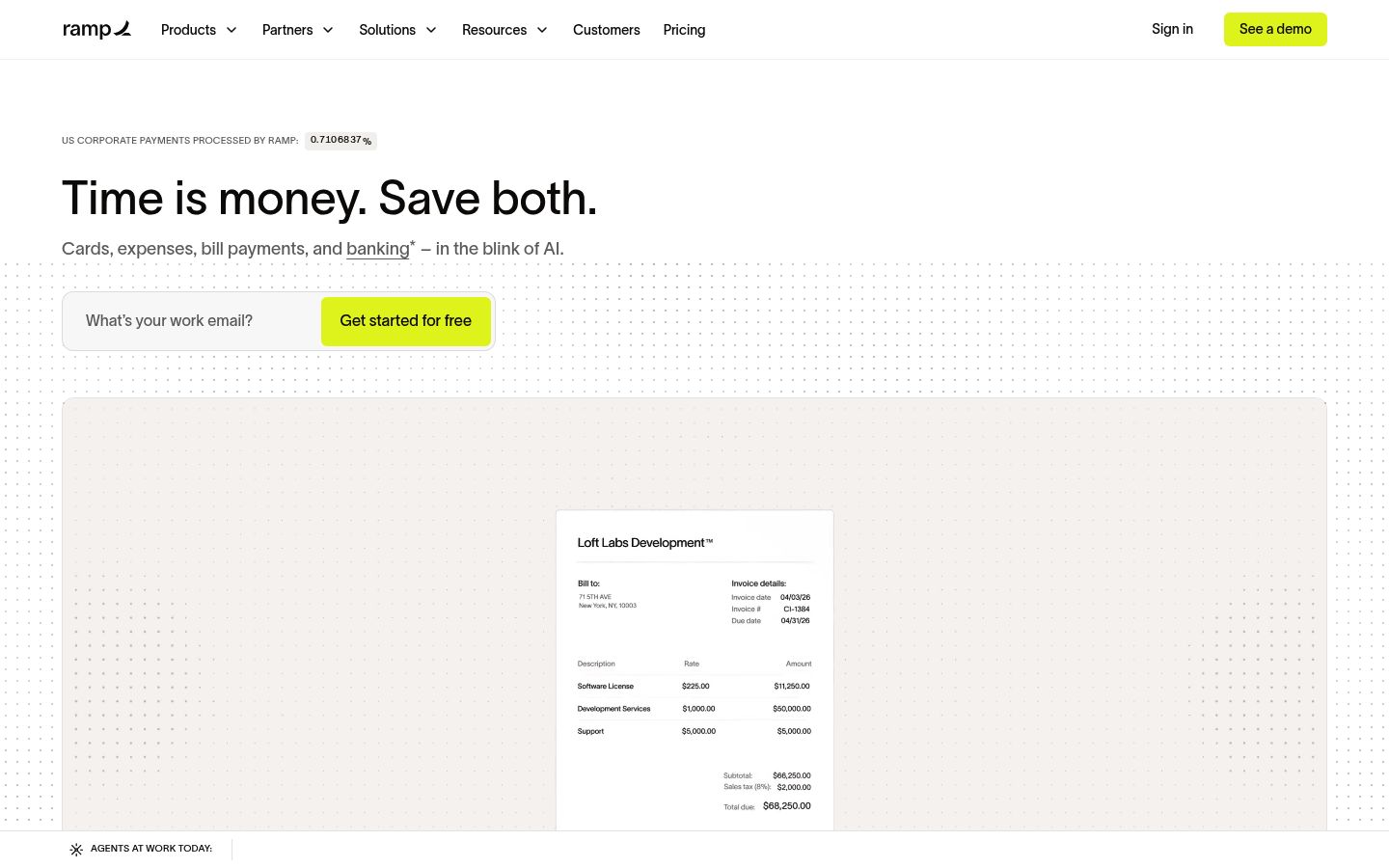
The page you submitted is a machine-readable document — structured for programmatic consumption, not for a human buyer making a decision. There is no hero, no visual hierarchy, no CTA, and no conversion surface anywhere on the page. A finance leader who lands here has no path to act: nothing tells them what to do next, where to start, or how to get access. This isn’t a positioning problem or a copy problem — it’s a missing page problem. The audit target needs a human-facing homepage that opens with the buyer’s situation, gives them a reason to stay, and asks them to do something specific before they leave.
Ramp scored 6.0/10.
Free tier pricing signals a self-serve buyer; every proof point on the page was built for a CFO.
The hero on Ramp’s page as we read it.
Ramp — Machine Version
Where Ramp wins and where it leaks.
Ramp’s strongest dimension is Trust.
Trust scores 6.4 / 10. The dim covers 3 signals in the rubric; the page still has 2 findings in this area, but the overall score is strong relative to peers.
Structural patterns on Ramp’s page worth knowing.
The subheadline — “an all-in-one spend management platform that combines corporate cards, expense management, accounts payable, travel, procurement, and accounting automation into a single system” — is a category description, not a position. Bill.com, Brex, and Concur all make a version of this same claim. The page lists every module Ramp offers but never names the one thing Ramp wins on. The customer quotes buried in the proof section get closer: “People ask how we’re using AI in finance and I have a simple answer. We use Ramp.” That’s a positioning claim. The page should open with it, not bury it after a feature inventory. Pick the one axis Ramp owns — AI automation that handles the work before the finance team touches it — and build the entire page around that claim, cutting everything that dilutes it.
The proof is rich but structurally scattered. The page lists twenty-plus customer outcomes — hours saved, days faster, tools replaced, ROI achieved — but presents them as a flat list with no hierarchy. The most powerful data points (Poshmark hitting free cash flow goals 5 months early; Advisor360° achieving 4x ROI in under a year; Glossier auto-coding 90% of transactions) are buried alongside smaller wins with no visual or structural distinction. A finance leader scanning for evidence that Ramp works for a company like theirs has to read every line to find it. Cluster the proof by buyer type or outcome category, lead with the three or four outcomes that are hardest to ignore, and let the rest support rather than compete.
The pricing section creates a structural contradiction the page never resolves. Free and Plus tiers are priced for self-serve buyers — $0 and $15 per user per month — but the ICP named throughout the page is a CFO or controller at a mid-market or enterprise company evaluating a platform to replace Concur or Bill.com. That buyer does not self-serve into a $15/user/month tool; they evaluate, they pilot, they negotiate. There is no demo path, no “talk to us” surface, no enterprise-first entry point anywhere on the page. The pricing structure signals one buyer; the proof and feature depth signal another. Either add a prominent enterprise path above the pricing section or restructure the tiers so the enterprise buyer sees their entry point before the self-serve buyer sees theirs.
What’s costing Ramp, quoted from the page.
- 01Your 50,000+ customer claim is doing no work.
“The social proof section names six companies inline but presents no logos above the fold. The named testimonial companies — Joffrey Ballet, Construction One, Gills Onions, Rustic Canyon — are small businesses, not the mid-market or enterprise finance teams your ICP describes. A C…”
Your 50,000+ customer claim is doing no work. It sits in a single line with no logos, no names, and no context — and the six logos listed (Notion, Shopify, Webflow) skew startup, not mid-market finance.
- 02Your customer proof is all time and hours — no named customer speaks to cost savings or ROI in a way that lands for a CFO evaluating budget.
“The page lists 20+ customer outcomes. Nearly all are time-based (hours saved, days faster, FTEs saved). Two dollar-figure outcomes exist — Candid's $250K and Advisor360°'s $80K — but both are attributed to specific tools (insight tool, cashback) rather than the platform overall. …”
Your customer proof is all time and hours — no named customer speaks to cost savings or ROI in a way that lands for a CFO evaluating budget. Finance leaders approve platforms on financial return, not productivity metrics.
- 03Your subheadline describes the category, not why Ramp wins.
“Ramp is an all-in-one spend management platform that combines corporate cards, expense management, accounts payable, travel, procurement, and accounting automation into a single system.”
Your subheadline is a category definition — it tells a CFO what spend management software is, not why Ramp is the right one. Every competitor on your comparison table could run this sentence verbatim. The actual wedge (30-day implementation, AI that handles 100% of expenses, no personal liability) doesn't appear until well below. The first sentence they read does zero work to separate you from Brex, Bill.com, or Concur.
- 04Your homepage argues product comparison to a mostly solution-aware crowd.
“The page targets product-aware buyers: the hero frames Ramp as a unified platform that beats named competitors ('7x fewer clicks than Bill.com,' 'replaced Zip and Concur'), assuming visitors already want a consolidated spend platform and are comparing options. But 54.97% of inbou…”
Your page opens with the all-in-one consolidation pitch and competitor comparisons — the right message for someone already shopping between Ramp, Brex, and Concur. But over half your traffic (54.97%) arrives from queries like 'how to create invoice' and 'per diem': they have a specific pain, not a platform-buying frame. The page never makes the case for why one unified system beats their current patchwork of tools — it just assumes that conclusion is already reached. That gap means the majority of your traffic hits a message that's one step ahead of where they actually are.
- 05Marketing touts global unified system; buyers ask for rolling forecasts and FP&A not present in product scope
“"The only vendor servicing all employees globally in one unified system" — Brandon Zell, Chief Accounting Officer”
Your page positions Ramp as an all-in-one system covering every finance workflow, and a testimonial explicitly calls it 'the only vendor servicing all employees globally in one unified system.' However, buyers at 65% frequency ask for 'rolling forecasts and scenario modeling' and 42% want to 'keep Excel but centralize FP&A' — capabilities absent from the listed core products (Cards, Expenses, AP, Travel, Procurement, Intelligence, Accounting Automation, Treasury).
Ramp’s other surfaces.
- ramp.comHomepage
- ramp.com/pricingTracked
- ramp.com/customersTracked
About Ramp’s Lytms scan.
What did Lytms score Ramp's homepage?
What's Ramp's strongest dimension?
What's the weakest dimension on Ramp's page?
What's the biggest leak on Ramp's homepage?
How does Ramp compare to peers?
When was Ramp's page last scanned?
One-click citation for press, blog, and academic use.
Lytms scans of public B2B SaaS landing pages are independent and free to cite. Pick a format below and we’ll copy it to your clipboard.
Lytms Research Team. (2026). Ramp landing page review (Lytms score 6.0/10). Retrieved May 17, 2026 from https://lytms.ai/brand/ramp
