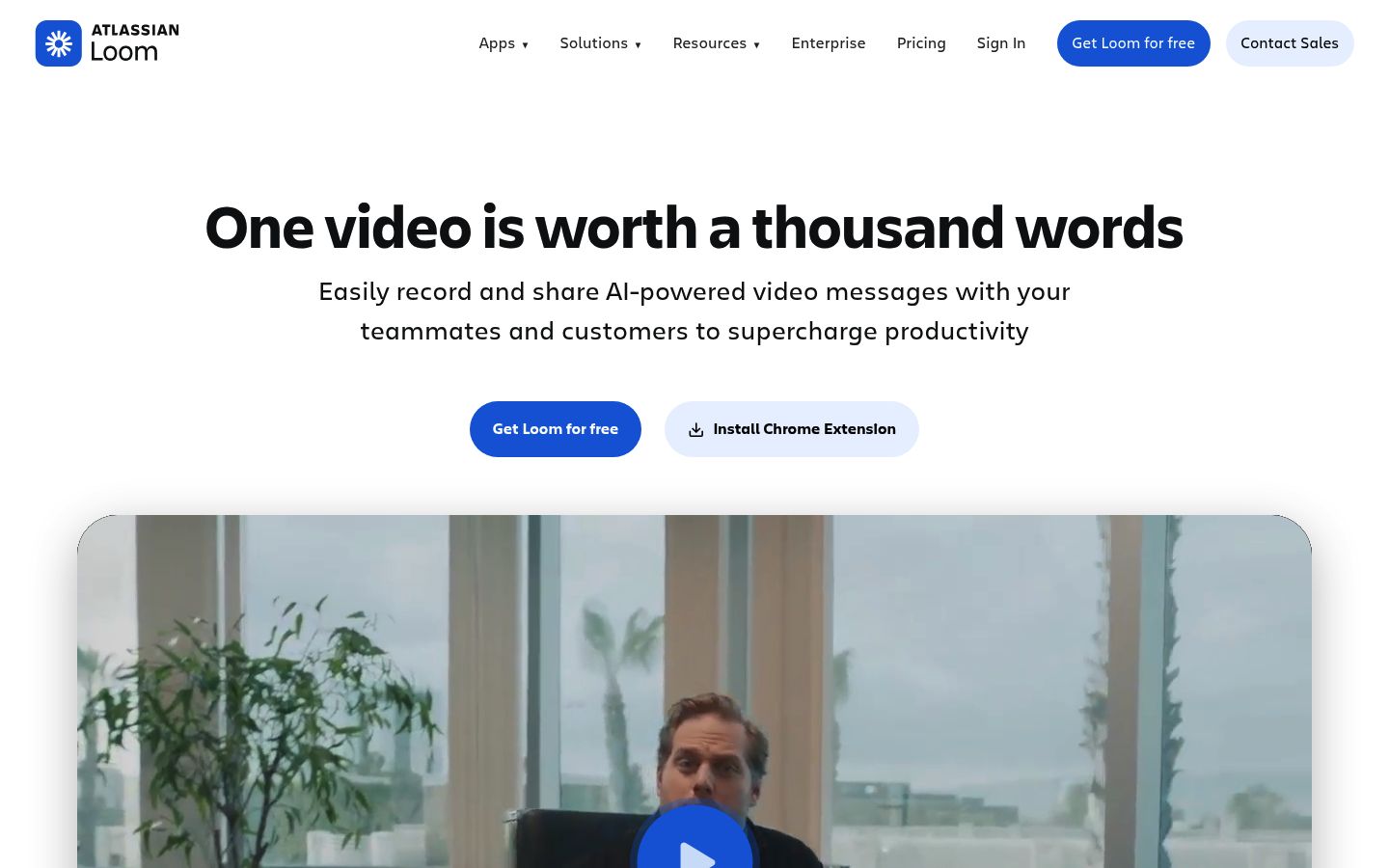
The page is trying to convert two completely different buyers with one message, and it’s converting neither cleanly. The hero targets a self-serve individual (“Get Loom for free,” “the easiest screen recorder you’ll ever use”) while the body pivots to enterprise signals — SSO, SCIM, custom data retention, a dedicated Enterprise section, and testimonials from a Chief People Officer and a Co-CEO. A solo user who lands on “free” and “easy” reads three sections before hitting enterprise security copy and loses the thread of what they signed up for. An enterprise buyer who lands on the page sees “free” and “easiest screen recorder” and wonders if this is a serious tool for their org. Split the page into two distinct paths above the fold — a self-serve entry and a team/enterprise entry — or pick the primary buyer and build the page for them, with the secondary path as a secondary CTA.
Loom scored 5.4/10.
Kieran Flanagan's testimonial nails what Loom is — the hero doesn't, and it's buried in a carousel.
The hero on Loom’s page as we read it.
One video is worth a thousand words
Where Loom wins and where it leaks.
Loom’s strongest dimension is CTA & Offer.
CTA & Offer scores 6.8 / 10. The dim covers 5 signals in the rubric; the page still has 1 finding in this area, but the overall score is strong relative to peers.
Structural patterns on Loom’s page worth knowing.
The hero headline, “One video is worth a thousand words,” positions Loom as a generic communication upgrade rather than the specific category it actually owns. Every async video tool, every Vidyard, every Zoom clip feature, every Slack huddle could run this headline without changing a word. The page has a real positional claim available — Loom is the tool that replaces the meeting you were about to schedule, the email chain that was about to take three days — but the hero buries it in the subheadline behind “AI-powered” and “supercharge productivity,” two phrases that appear on competitors’ pages verbatim. Kieran Flanagan’s testimonial (“Begin writing an email. Get to the second paragraph and think ‘what a time suck.’ Record a Loom instead.”) is the sharpest articulation of Loom’s actual value on the entire page, and it’s sitting in a carousel. Move that specific behavior — the moment of switching from email to video — into the hero, because that’s the word Loom should own: the replacement.
The AI bug report feature is introduced as “New!” in the body with its own “Learn more” link, but it’s positioned as a product announcement rather than a reason to choose Loom over anything else. This is the most differentiated thing on the page — no competitor is offering automatic Jira ticket population from a screen recording — and it’s treated like a changelog entry. A developer or engineering lead who lands on this page and is evaluating Loom against Zoom’s built-in recording or Slack clips would have no idea this feature exists until they scroll past the hero, past the “easiest screen recorder” section, past the editor features. Pull the bug report capability into the hero or into a dedicated above-the-fold proof point aimed at engineering buyers, because right now the page’s most defensible claim is hidden behind generic copy.
The testimonials are named and credible — HubSpot, Typeform, Meta — but they’re all deployed in a carousel, which means most visitors see one or two before moving on, and the page never uses them to answer a specific objection. Katie Burke’s quote about connecting personally without “75 different one-on-one calls” directly addresses the meeting-replacement use case. Erica Goodell’s quote about “hundreds of hours” directly addresses ROI. David Okuinev’s quote about executive communication directly addresses the enterprise buyer. None of these are placed adjacent to the claim they support — they’re pooled together in a rotating strip that treats all proof as interchangeable. Anchor each testimonial to the section it validates: put the hours-saved quote next to the productivity claim, put the executive quote next to the Enterprise section, put the meeting-replacement quote in the hero.
What’s costing Loom, quoted from the page.
- 01The page opens on async productivity while most traffic wants a screen recorder.
“The page leads with 'One video is worth a thousand words' and AI-powered team productivity — framing that assumes visitors already want an async video messaging tool. But 53.99% of inbound search volume is solution_aware traffic searching for 'how to screenshot on mac', 'how to s…”
Your page opens by selling the vision — async video as a productivity layer for teams — before it's confirmed you can do the thing these visitors searched for. Over half your traffic (53.99% solution_aware) arrived asking 'how do I record my screen on a Mac,' not 'how do I replace meetings with video.' The page body does mention 'The easiest screen recorder you'll ever use,' but that's below the hero, after a pitch about AI, teammates, and supercharging productivity. The awareness gap is a cold-to-hot compression problem: the top of your page assumes a warm buyer; the majority of your traffic is cold.
- 02The page never tells a visitor where to go next based on who they are.
“The page has one primary CTA ('Get Loom for free') and one secondary enterprise path ('Learn more') with no routing logic between them. The use-case section lists Sales, Engineering, Customer Support, and Design — but none of those links lead to a differentiated landing experienc…”
The page never tells a visitor where to go next based on who they are. A solo user and an enterprise IT buyer hit the same single CTA and have to self-sort from there.
- 03Your hero subheadline ends on the most generic phrase in SaaS.
“Easily record and share AI-powered video messages with your teammates and customers to supercharge productivity”
The subheadline builds specific, credible momentum — async video, AI-powered, share with teammates and customers — then throws it away with 'supercharge productivity.' That phrase is on the homepage of virtually every tool competing for the same buyer's attention. It replaces a concrete promise with a generic one at the exact moment the visitor is deciding whether to read further.
- 04Pricing transparency absent despite it being buyers' #2 concern
“Millions of people across 400,000 companies choose Loom [no pricing information present on page]”
The page makes no reference to pricing structure or per-seat costs, while buyer voice ranks 'per-seat pricing that doesn't scale into chaos' at 82% frequency and lists 'pricing per seat visible without a sales call' as an explicit table stake. The page's only commercial signal is a free CTA, leaving the cost model entirely unaddressed.
- 05The enterprise section is a single line of text and a 'Learn more' link at the bottom of the page.
“'Loom for Enterprise helps teams securely manage and organize async video communication at scale' — one sentence, no named customers, no security certifications, no team-size framing, placed after the blog section. Customer logos (MetaLab, HubSpot, Typeform, Pearson) exist on the…”
The enterprise section is a single line of text and a 'Learn more' link at the bottom of the page. For a product with SSO, SCIM, custom data retention, and named enterprise customers, that's a near-invisible pitch to your highest-value buyers.
Loom’s other surfaces.
- loom.comHomepage
- loom.com/pricingTracked
- loom.com/enterpriseTracked
About Loom’s Lytms scan.
What did Lytms score Loom's homepage?
What's Loom's strongest dimension?
What's the weakest dimension on Loom's page?
What's the biggest leak on Loom's homepage?
How does Loom compare to peers?
When was Loom's page last scanned?
One-click citation for press, blog, and academic use.
Lytms scans of public B2B SaaS landing pages are independent and free to cite. Pick a format below and we’ll copy it to your clipboard.
Lytms Research Team. (2026). Loom landing page review (Lytms score 5.4/10). Retrieved May 17, 2026 from https://lytms.ai/brand/loom