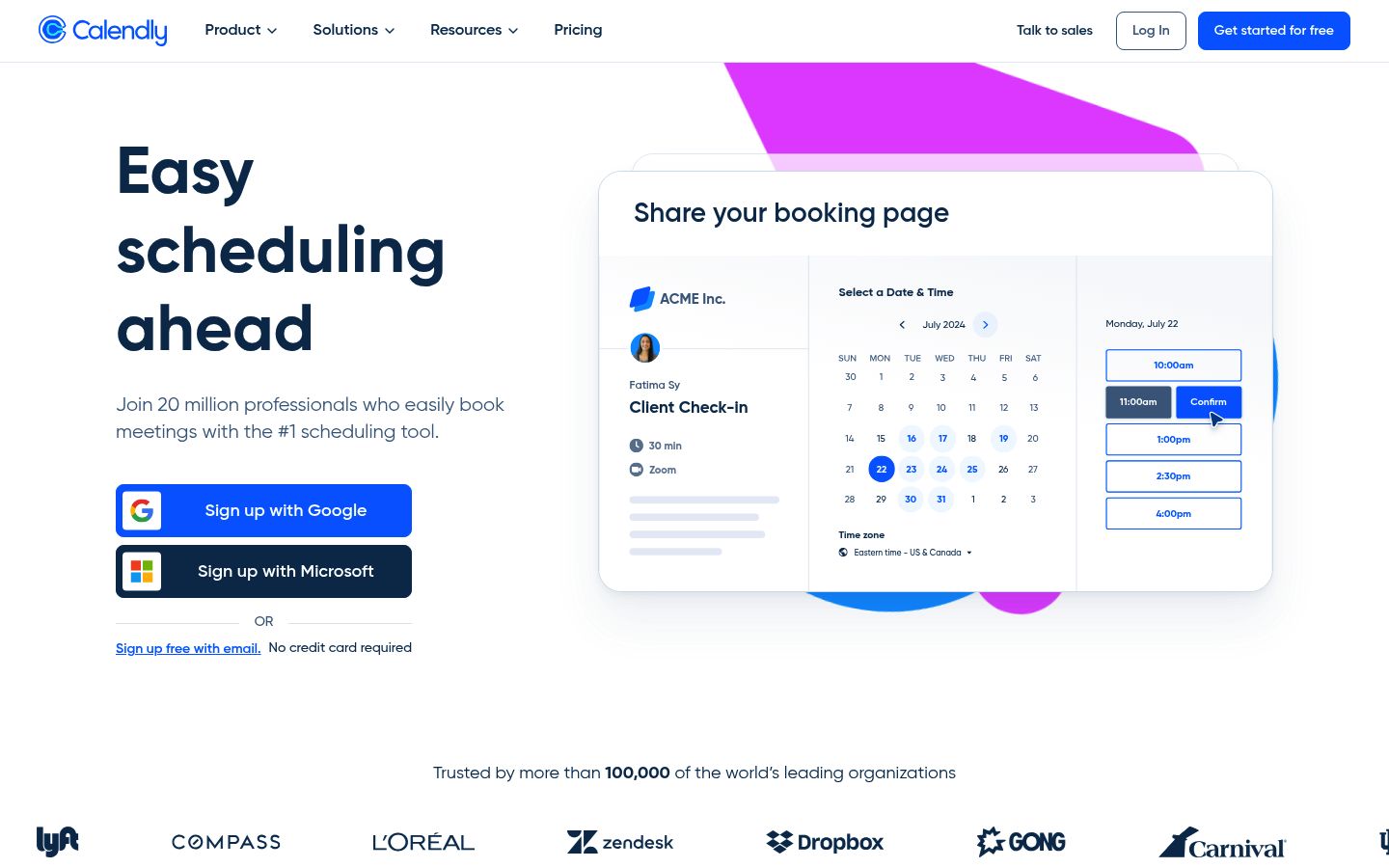
The page tries to be two products at once and ends up being neither. The hero says “easy enough for individual users, and powerful enough for enterprise organizations” — and then the body copy lists enterprise-grade admin management, compliance audits, and data governance alongside a free tier and a $10/seat plan. A solo user scanning for a simple booking link doesn’t need to hear about compliance audits; an enterprise buyer evaluating a $15k/year contract doesn’t want to be grouped with free-tier individuals. The page is trying to hold both audiences simultaneously, and the result is that neither one feels like the page was built for them. Split the page by entry point — a self-serve path for individuals that leads with the free signup and gets them to a working link in under two minutes, and an enterprise path that leads with the Fortune 500 proof and the security and compliance story. The current single-page compromise serves both audiences poorly.
Calendly scored 5.4/10.
Your hero confirms what every buyer already believes; the page never says why Calendly beats doing nothing.
Where Calendly wins and where it leaks.
Calendly’s strongest dimension is CTA & Offer.
CTA & Offer scores 8.5 / 10. The dim covers 5 signals in the rubric; no findings landed against it on this page — clean execution.
Structural patterns on Calendly’s page worth knowing.
The five ROI metrics in the proof section are floating without any anchor, and that makes them unbelievable rather than persuasive. “169% return on investment” and “160% increase in customers reached” appear as standalone numbers with no named customer, no industry context, no explanation of how they were measured. A buyer who’s evaluating a $15k/year contract will ask: 169% ROI for whom — a sales team, a recruiting team, a solo consultant? The number means something completely different depending on the answer, and the page never answers it. Replace the floating metrics with two or three named customer outcomes: the company, the team size, the specific use case, and the result. One attributed outcome from a recognizable company will do more work than five unattributed statistics.
The page leads with “Calendly makes scheduling simple” — a headline that tells the buyer nothing they couldn’t have guessed before they arrived. Calendly is the category-defining product in scheduling automation; the buyer already knows it makes scheduling simple. That’s why they’re here. The headline is spending its most valuable real estate confirming what the visitor already believes instead of advancing a reason to choose Calendly over Google Calendar’s native scheduling, over a simple Outlook booking link, or over doing nothing. The page has a real differentiation story buried in the body — multi-calendar sync, round-robin team routing, 100+ integrations, enterprise compliance — but the hero doesn’t surface any of it. Rewrite the hero around the specific outcome that separates Calendly from the free alternatives the buyer is already using, not around the category promise they already accept.
The pricing table sits on the same page as the enterprise proof, and the gap between them creates a credibility problem. The page tells a Fortune 500 buyer that 86% of their peers use Calendly, then shows them a pricing table where the entry point is $10 per seat per month. The enterprise tier — which starts at $15,000 per year — is listed last, in the same table, next to a free plan. An enterprise buyer reading this doesn’t see a product built for their scale; they see a self-serve tool with an enterprise add-on bolted on. Move the enterprise proof and the enterprise pricing into a separate section or a separate path entirely. The $10/seat table is the right surface for the self-serve buyer; it’s the wrong context for the buyer you’re trying to close at $15k.
Calendly’s other surfaces.
- calendly.comHomepage
- calendly.com/pricingTracked
- calendly.com/enterpriseTracked
About Calendly’s Lytms scan.
What did Lytms score Calendly's homepage?
What's Calendly's strongest dimension?
What's the weakest dimension on Calendly's page?
How does Calendly compare to peers?
When was Calendly's page last scanned?
One-click citation for press, blog, and academic use.
Lytms scans of public B2B SaaS landing pages are independent and free to cite. Pick a format below and we’ll copy it to your clipboard.
Lytms Research Team. (2026). Calendly landing page review (Lytms score 5.4/10). Retrieved June 11, 2026 from https://lytms.ai/brand/calendly
Score yours like Calendly. See yours.
One URL. About 2 minutes.