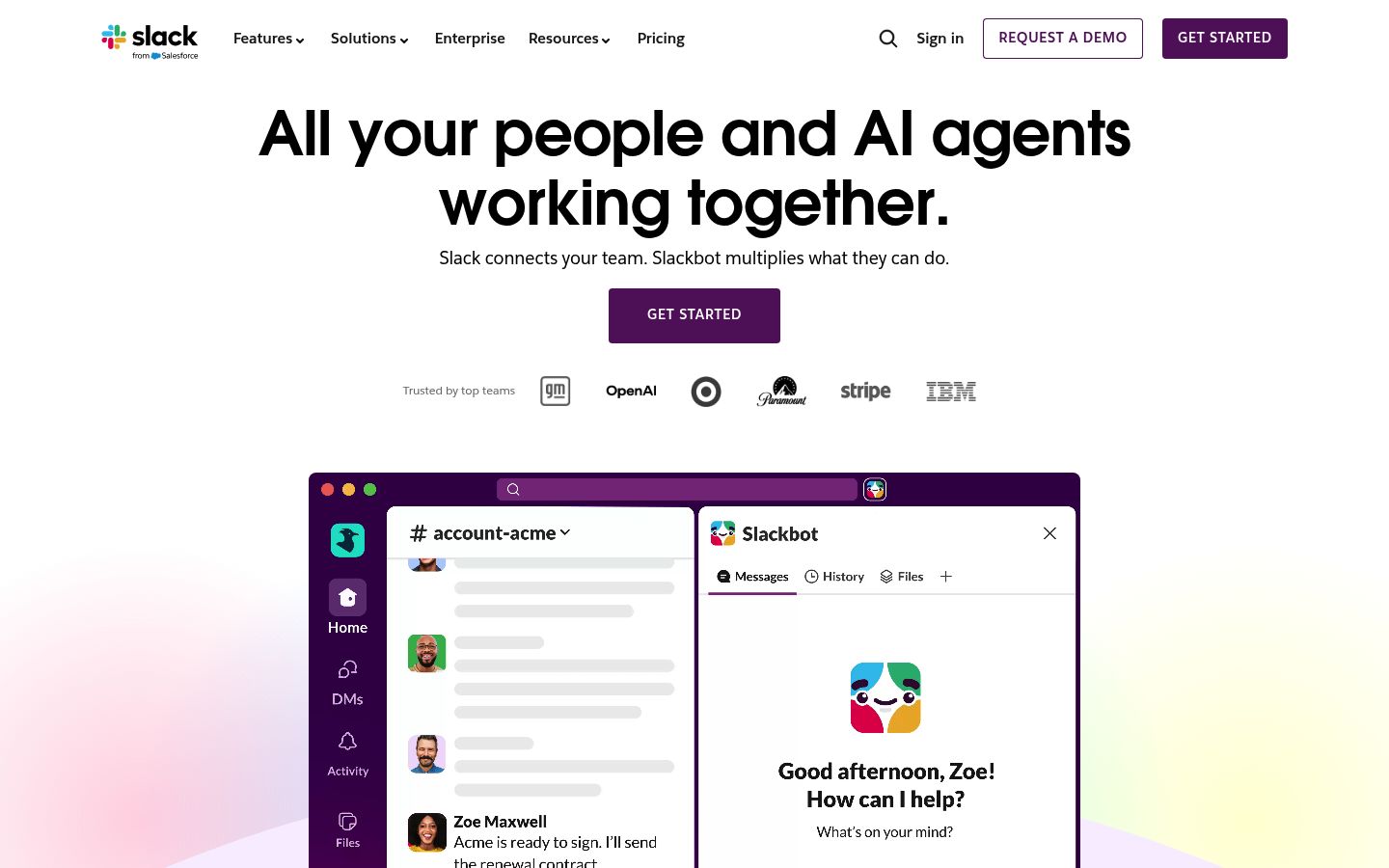
The page opens with “All your people and AI agents working together” — a headline that describes a category shift Slack is betting on, not a reason for any specific buyer to stay on the page. The problem is that Slack’s actual visitor population splits hard between two groups: teams already using Slack who came to understand what the AI layer does for them, and buyers evaluating Slack against Microsoft Teams who need a reason to choose it. The headline serves neither. The existing Slack user needs to know what changes for them specifically — what Slackbot does that they can’t do today. The Teams evaluator needs to know why Slack wins on the AI dimension, not just that AI exists here too. One headline cannot hold both audiences, and right now it holds neither. Split the page or pick the buyer who matters more to the business right now, then write the hero for that person.
Slack scored 6.0/10.
The page claims Slackbot is the differentiation, then demonstrates it entirely through Claude, Copilot, and Agentforce — other companies' AI.
The hero on Slack’s page as we read it.
All your people and AI agents working together.
Where Slack wins and where it leaks.
Slack’s strongest dimension is Craft.
Craft scores 7.4 / 10. The dim covers 4 signals in the rubric; the page still has 1 finding in this area, but the overall score is strong relative to peers.
Structural patterns on Slack’s page worth knowing.
The page makes four distinct claims across its four sections — Knowledge, People, Process, Platform — and treats them as equal pillars. This is the page trying to own four things simultaneously, which means it owns none of them. The actual differentiating claim buried in the body is Slackbot: an AI agent that knows your team’s history, coordinates across apps, and gets work done inside a single conversation. That claim is genuinely differentiated from what Microsoft Teams is shipping and what standalone AI tools can offer. But it appears in the third paragraph of the page, after a section header, after a stat callout, after the hero. The page’s architecture treats Slackbot as one feature among many. It should be the organizing frame for the entire page — the thing everything else proves.
The testimonials from Anthropic and Vercel are doing the wrong job. Guillermo Rauch says “we see Slack as the natural place to build our agents” — that’s a developer-building-on-Slack quote, not a buyer-using-Slack quote. Kate Jenson says Slack helped Anthropic stay aligned as they scaled — that’s a generic collaboration endorsement that Microsoft Teams could run without changing a word. Neither quote names the specific outcome that Slack’s positioning depends on: that Slackbot or AI in Slack did something no other tool could do. The page has a case study about MrBeast and Slackbot helping create viral videos — that’s a more specific, memorable proof point than either named testimonial — but it appears near the bottom, after the reader has already formed their impression. Move the most specific AI proof to the top; replace the generic endorsements with quotes that name what the AI actually did.
The stat “97 minutes saved weekly with AI in Slack” appears mid-page with a footnote that traces it to an internal pilot analysis. The number is credible and specific, which is good. But the page never tells the buyer what those 97 minutes were spent on before, or what the buyer does with them after. “97 minutes saved” is an input metric; the buyer wants to know the output — what their team ships, closes, or resolves with that time back. The page has the raw material to make this concrete: channel recaps, thread summaries, AI search answers are named in the footnote. Build a before/after around one of those specific use cases directly adjacent to the stat, so the number lands as a felt outcome rather than a survey result.
What’s costing Slack, quoted from the page.
- 01Message history limits unaddressed on page despite being a named buyer friction point
“'AI-powered search puts your company's entire memory at your fingertips.'”
The page promotes 'One search to rule them all' and 'AI-powered search puts your company's entire memory at your fingertips,' implying unlimited or unrestricted access to conversation history. Buyers, however, explicitly flag 'message history without hitting a wall' (62%) and the free-tier message history wall as a red-flag switching trigger, a constraint the page never acknowledges.
- 02The page has two CTAs in the hero — 'Get started' and 'Find your subscription' — but neither tells a most-aware buyer what happens next.
“The hero CTA is 'Get started' with a secondary 'Find your subscription.' No CTA is labeled 'Request a demo,' 'Talk to sales,' or 'See it for enterprise.' The demo CTA only appears at the very bottom of the page. Enterprise buyers who won't self-serve on a free trial have no clear…”
The page has two CTAs in the hero — 'Get started' and 'Find your subscription' — but neither tells a most-aware buyer what happens next. Enterprise buyers evaluating Slack against Teams need a demo path that signals enterprise treatment, not a generic signup button.
- 03The page never tells a skeptical buyer what Slack costs, or even what tier unlocks the AI features being pitched.
“No pricing information, tier names, or 'see pricing' link appears anywhere in the page content. The CTA 'Find your subscription' implies pricing exists elsewhere, but the page doesn't surface it. AI features (channel recaps, Slackbot, AI search) are central to the pitch but their…”
The page never tells a skeptical buyer what Slack costs, or even what tier unlocks the AI features being pitched. A buyer who lands here to evaluate Slackbot against Teams Copilot has no way to compare total cost without leaving the page.
- 04Your security section makes an absolute claim that enterprise buyers won't believe.
“If it's shared in Slack, it's safe.”
The page makes an unconditional promise — 'if it's shared, it's safe' — with nothing behind it. For the security-conscious buyer whose job it is to evaluate exactly this claim, the absence of any qualifier or evidence doesn't read as confidence; it reads as a brand that hasn't thought carefully about what it's saying. The rest of your Platform section earns credibility ('purpose-built,' 'tailored to fit'); this sentence spends it.
- 05The subheadline doesn't say why Slackbot beats Teams Copilot.
“All your people and AI agents working together. | Slack connects your team. Slackbot multiplies what they can do.”
The page tells most-aware buyers that Slackbot 'multiplies what they can do' without naming what it multiplies, or how. Microsoft Teams Copilot says almost the same thing. A buyer who already knows Slack reads this and gains no reason to act today.
Slack’s other surfaces.
- slack.comHomepage
- slack.com/pricingTracked
- slack.com/customersTracked
About Slack’s Lytms scan.
What did Lytms score Slack's homepage?
What's Slack's strongest dimension?
What's the weakest dimension on Slack's page?
What's the biggest leak on Slack's homepage?
How does Slack compare to peers?
When was Slack's page last scanned?
One-click citation for press, blog, and academic use.
Lytms scans of public B2B SaaS landing pages are independent and free to cite. Pick a format below and we’ll copy it to your clipboard.
Lytms Research Team. (2026). Slack landing page review (Lytms score 6.0/10). Retrieved May 20, 2026 from https://lytms.ai/brand/slack
Score yours like Slack. See yours.
One URL. About 2 minutes.